Agentic commerce infrastructure

The trust and transaction layer for consumer agentic commerce.

Your customers are moving into their own LLMs — and sending agents ahead of them. Pattern Engine provides the session and service orchestration that lets them engage with you as a brand where they want, with permissions, identity, and writes to your systems of record handled properly. No human will be there to overlook the transaction. The system has to be.

Deployed in your cloud. SOC 2 and HIPAA intact. In the order path, as software.

62%

of US adults 18–64 now use generative AI

St. Louis Fed, Q2 2026
60%↑

better conversion from AI-referred retail traffic — eleven consecutive months

Adobe, Jul 2026
2×

conversion for AI search on a structured catalog vs. scraped product data

Shopify earnings
<1%

of product pages are parseable by an LLM today

Mirakl, Aug 2026
The thesis

Consumer agents are coming. The curve says faster than anything before them.

For the first quarter of this century, brands fought for human attention on browsers and mobile devices. There is a straight line from ecommerce, through social and mobile, to AI — and the next several years will be a battle for the attention of agents acting on behalf of humans.

LLMs are the fastest-adopted consumer technology ever measured. They reached half of US working-age adults in about 2.6 years and a billion weekly users in 3.7 — against 5.6 and 7.5 years for smartphones, and 7.9 and 8.7 for social media. At the three-year mark, generative AI had reached roughly 55% of working-age adults; the PC and the internet sat near 20% at the same age.

Discovery has already moved. AI-referred traffic to US retail grew 393% year over year in Q1 2026 and now converts about 60% better than non-AI traffic — a complete reversal from a year earlier, when AI visits were worth less than half as much. Shopify saw AI-referred orders triple, with half of AI sessions landing directly on a product page. And 75% of AI-attributed purchases fall outside the top hundred categories: agents shop the long tail humans never scroll to.

But the capability is ahead of the commerce. Agent-executed checkout is still roughly 1.5% of US ecommerce. It mirrors the early days of mobile commerce — the phones were in every pocket while the sites were unusable on them. The traffic is arriving before the infrastructure, and the brands that built for mobile early took the decade that followed.
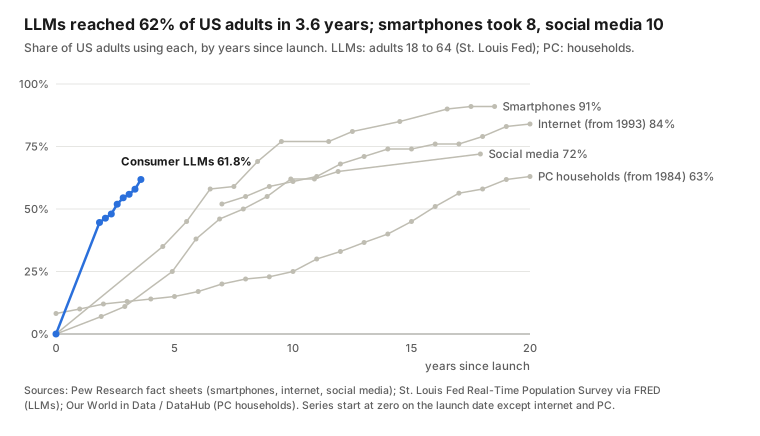
LLMs reached 62% of US adults in 3.6 years; smartphones took 8, social media 10

US adoption by years since launch. LLMs reached 62% of adults in 3.6 years; smartphones took 8, social media 10. Source: St. Louis Fed, Pew — verified series.
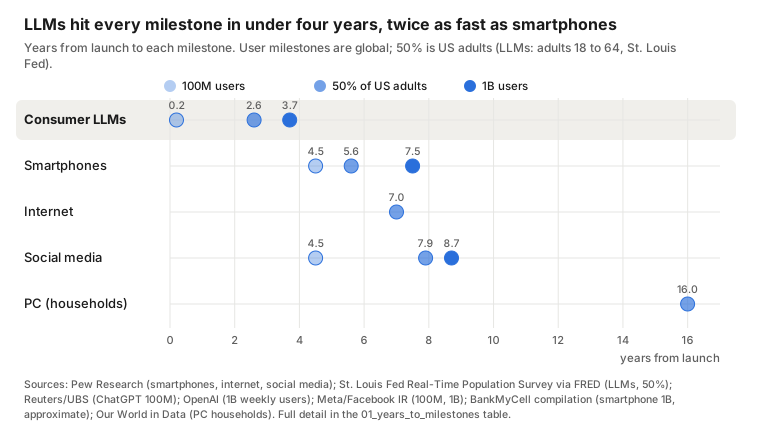
LLMs hit every adoption milestone in under four years, twice as fast as smartphones

Years to each milestone: LLMs hit every one in under four years — twice as fast as smartphones.
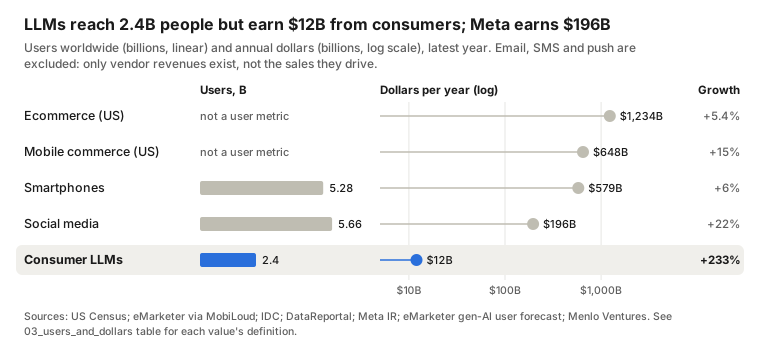
LLMs reach 2.4 billion people but earn $12B from consumers; Meta earns $196B

LLMs reach 2.4B people and earn ~$12B from consumers; Meta earns $196B on fewer. The gap between LLM users and LLM dollars is the opening.

The trust gap

Identity shipped. Intent attestation shipped. Decision integrity did not.

Every protocol launched in the last two years verifies who the agent is. None verifies whether its decision matched the customer's intent — or gives the brand a safe way to let a permissioned agent act. That gap is the work.

01

Consumer agents are coming

The adoption curve above is the fastest on record, platform shopper agents are live, and agent traffic is now the majority of the web — AI agent requests grew 1,700% year over year. Non-human behavior is no longer a red flag; it's the customer.

Cloudflare, Sep 2026 · Signifyd

02

Agent transactions demand high trust and real permissions

There is no liability shift for agent-made transactions, and nothing in the dispute system even labels one. Contract law already binds the merchant — an agent-formed contract is enforceable "even if no individual was aware of or reviewed the electronic agent's actions." The party with the least control over the decision retains the dispute exposure.

Consumers feel it too: willingness to let an agent buy rises from 23% to 61% when a trusted party is named as executor. Liability, not technology, is the bottleneck.

Worldpay, Apr 2026 · UETA §14 · Capgemini

03

Brands need agent-ready account & permission structures

When a human shops, the human is the safety net. When their agent shops, your systems are. The agent needs scoped, revocable access to the account you own — the customer's purchases, preferences, shipping details, everything you know about them — because no one is watching the screen.

Amazon didn't block Meta's shopping agent over fraud. It blocked it over consent, self-identification, and credential custody. Walmart pulled roughly 200,000 products from agent checkout over wrong items and unverifiable availability. Governance and accuracy, not fraud, are the gates.

Amazon, Sep 2026 · Reuters / Bloomberg coverage

04

The rails exist. Adoption hasn't happened.

MCP, ACP, UCP, AP2, Visa TAP, Mastercard Agent Pay — the standards landed in every channel inside an 18-month window. Mobile took seven years to get platform-native specs; agentic took about fifteen months. Yet merchants face a protocol-proliferation tax of $5,000 to $500,000 per standard, 42% are testing while only 3% of transactions involve an agent, and the proof the rails work at volume is overseas: Alipay processed 300M+ agent transactions in its first three months.

EVIDENCE ledger · Forrester · Checkout.com

"Inventory management has been disastrously absent from the plan for agentic commerce."

Forrester, on OpenAI's pullback from in-chat checkout — March 2026
Conceptual architecture

Pattern Engine runs alongside your systems — between your brand and every agent surface.

Managed agents and permissioned tools deploy in your cloud, speak the open standards outward, and read from and write to your systems of record inward — without disruption, and without a human in the loop to catch what the system should have caught.

WHERE YOUR CUSTOMERS ARE YOUR CLOUD Their LLM The customer's surface ChatGPT Gemini Claude Copilot & others Consumer agent Acting on the customer's mandate — researching, comparing, transacting OPEN STANDARDS MCP tools & context ACP · UCP commerce & checkout AP2 payment mandates TAP · Web Bot Auth agent identity OAuth scopes customer permissions DEPLOYED IN YOUR VPC · SOC 2 / HIPAA INTACT Pattern Engine Session & service orchestration, in their LLM Managed agents · Evaluated on every generation · Voice & epistemic canon · Approval gates for consequential actions · Versioned, with provenance Permissioned tools · Profile & preferences · Catalog & availability · Orders & subscriptions · Post-purchase service · Scoped to the customer, revocable Permissions & policy Your account & permission structures — per session, per scope Observability · evals · audit Eval loops, session cost tracking, evidence for every decision PARALLELIZED AT CLOUD SCALE Thousands of concurrent sessions — not one browser at a time SYSTEMS OF RECORD Commerce / OMS orders, carts, checkout CRM & profile purchases, preferences, what you know of them Inventory stock, pricing, delivery promise Payments & loyalty you stay merchant of record the promise, verified: in stock · this price · delivered Thursday
Verified, permissioned agent traffic — read / write to systems of record, without disruption The promise path — availability-and-promise truth, back to the customer Your trust boundary — nothing leaves your cloud
A permissioned session, end to end
01

The customer delegates

In their own LLM, a signed-in customer authorizes their agent against your brand — a scoped, revocable grant, not a password handed to a bot.

02

The agent is verified

Pattern Engine checks who the agent is and what mandate it carries before any tool opens — identity, intent, and scope, per session.

03

Tools act on truth

Permissioned tools read the customer's real profile and your live inventory, pricing, and delivery promise — from systems of record, not a stale scrape.

04

Everything is evidenced

Every decision is evaluated, consequential actions gate on approval, and the audit trail exists before the dispute does.

The platform

Built for markets where the cost of being wrong is high.

Agents that act without a human watching have to be predictable, permissioned, and provable. That is the whole platform.

01

Predictable agents

Built-in, observable, quantifiable eval loops that iteratively and continuously improve. Our evals genuinely fail — they are not theater. Agents carry a voice canon that encodes epistemic stance, not just tone: a condition grade is a seller's claim, not a fact; a market price is a range with a source and a date.

Evals · provenance · approval gates
02

Properly permissioned tools

The agent can give your customer access to the account data you own — their purchases, their preferences, their shipping details, the things only you know about them. Scoped to the signed-in customer, revocable, and never a credential handed to a third party.

Account-scoped · revocable · consented
03

Alongside your systems of record

We deploy and control agents next to your systems — reading from and writing to your commerce, CRM, and inventory platforms without disruption. That's what makes the promise verifiable: in stock, this price, delivered Thursday, answered at agent-query time.

Read / write · no rip-and-replace
04

In your cloud, at cloud scale

Fast, performant implementation inside your VPC without sacrificing SOC 2 or HIPAA compliance. And parallelized: thousands of concurrent agentic sessions improving conversion at cloud scale — not a browser puppet clicking through your site one page at a time.

VPC · SOC 2 · HIPAA · parallel sessions
What's live today

The chat surfaces shipped. The brand side is thin.

Agentic checkout is live in every major chat experience. ChatGPT runs Instant Checkout on ACP. Perplexity ships Instant Buy. Microsoft Copilot checks out with the merchant staying merchant of record. Google's Universal Cart launched with Nike, Sephora, Target, Ulta, Walmart, and Wayfair. Meta's shopping agent pays with a single-use virtual card scoped to the approved purchase.

And MCP is already the substrate. Shopify ships WebMCP across 2M+ stores — get_checkout, update_checkout, complete_checkout — with UCP served over MCP. BigCommerce, SAP Commerce Cloud, Adobe Commerce, and commercetools all ship official MCP servers. The agent-to-tool plumbing exists.

But the generic in-chat leg underperforms. In-chat checkout converts under 1% against a 3–4% ecommerce norm, while 69% of AI-assisted shoppers still finish on the retailer's own site — and retailers with branded shopper agents are outgrowing those without. The winning pattern is own the assistant, rent the distribution.

What no platform ships is the brand side. Even the open-source reference shopping agent Anthropic released stops at the cart — no payments, no decision evidence, no observability, no approval governance. The missing piece is a permissioned MCP surface where the customer's agent — carrying the customer's mandate — can read the account you own, see live availability and pricing, and write the order back to your systems of record, with evidence. That is the Pattern Engine deployment.

Agent commerce surfaces, live nowLive
01ChatGPTInstant Checkout on ACP
02GoogleUniversal Cart — Nike, Target, Walmart, Sephora
03Copilotcheckout; merchant of record stays with you
04PerplexityInstant Buy — $0 commission, $0 listing
05Shopify WebMCPcheckout tools on 2M+ stores
06MCP serversBigCommerce · SAP · Adobe · commercetools

"These horizontal agents don't have any of your shopping history. They get a lot of the product details wrong, they get a lot of the pricing wrong."

Andy Jassy, Amazon CEO — Q4 2025 earnings call, February 2026
The rails

Eighteen months. Every channel.

Earlier commerce inflections were spread across two decades. The agentic one landed everywhere at once — and the standards are open, young, and still unevenly adopted. That is the window.

Apr 2025Mastercard Agent Pay · Visa Intelligent CommerceThe card networks commit to agent-initiated payments, a day apart.
Sep 2025Google AP2Payment mandates as verifiable credentials, launched with 60+ organizations; later contributed to the FIDO Alliance.
Sep 2025OpenAI + Stripe ACPAn open protocol for agent checkout, Apache-licensed, with a shared payment token design.
Jan 2026Google UCPCo-developed with Shopify, Target, Walmart and others — retailers remain the seller of record. Amazon, Meta, Microsoft and Stripe joined by April.
2025–26MCP everywhereThe agent-to-tool substrate ships from Shopify (2M+ stores), BigCommerce, SAP, Adobe and commercetools.
2026Agent identityVisa TAP, Web Bot Auth at the IETF, and signed-agent verification at the edge — identity is solved; decision integrity is not.

The adoption gap is the opportunity. Supporting one more protocol costs a merchant $5,000 to $500,000 — per standard, per stack. 42% of merchants are testing; 3% of transactions involve an agent; 72% fear consumer adoption will outpace their readiness. Meanwhile the one market that wired agents to payments at scale processed over 300 million agent transactions in its first three months.

We absorb the proliferation tax. Pattern Engine speaks the rails outward — MCP, ACP, UCP, AP2, agent identity — so your team integrates once, inward, against systems you already run. When the standards move, the engine moves; your systems of record don't.

Company

A product company from the start.

Pattern Factory builds verticalized service-as-software on one platform — a unified way of building, evaluating, and deploying agents that gets more capable with every generation. We choose markets where the cost of inaccuracy and unpredictability is high, because that is where predictable agents are worth the most.

We monetize on the conversion events we facilitate and the records we enrich — in the order path, as software, on a fee. Never on open-ended services.

How we engage

Design partners first

Each vertical opens with a small number of design partners who give us privileged access to real systems, processes, and data. What we build with them generalizes to the vertical — and compounds across the platform.

Now opening: agentic commerce design partnerships
Get ahead of the traffic

Be where your customers' agents are.

Discovery has already moved into LLM surfaces. Conversion stays with whoever holds the catalog, the account, and the promise. We make sure that's you.

Talk to us