The Next Battle Isn’t for Your Customers’ Attention. It’s for Their Agents’ Trust.
Brands spent twenty-five years fighting for human attention in browsers and apps. The next several years will be fought over the agents acting on humans’ behalf — and won on permissions, not impressions.
AI is redefining speed in growth rates
For the first quarter of the 21st century, brands have fought an incredible battle for the attention and dollars of humans on web browsers and mobile devices. Draw a line through the adoption curves of ecommerce, social media, mobile commerce, and now AI, and it points in one clear direction — each wave arrives faster than the last, and the next one is already here.
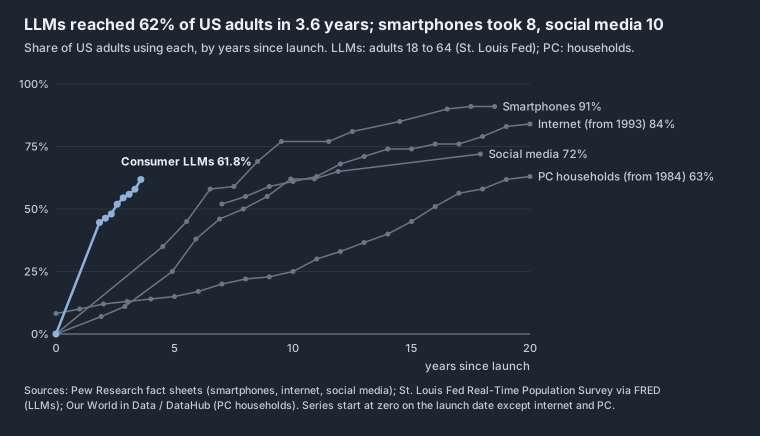
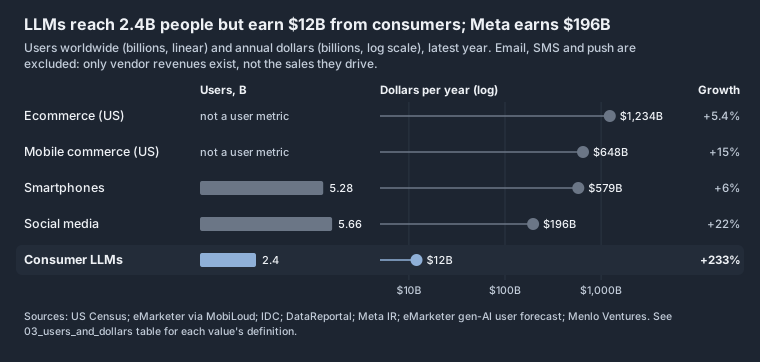
Consumers have adopted LLMs faster than any of those earlier technologies, each of which redefined rapid growth in its own day. And yet, for all their capability, there is still very little we can actually do with these tools — and so the commerce flowing through them remains small.
LLM-driven commerce is not commensurate with that user base
To a certain extent, it mirrors the early days of mobile commerce, when phones could mostly send text messages and take pictures. You could reach the world wide web, but through a degraded — sometimes unusable — interface; responsiveness was not the order of the day. You could take a picture, but in a world before 3G wireless, sharing it was painful — more painful still once cameras evolved to shoot live video.
Early mobile commerce saw challenges as well
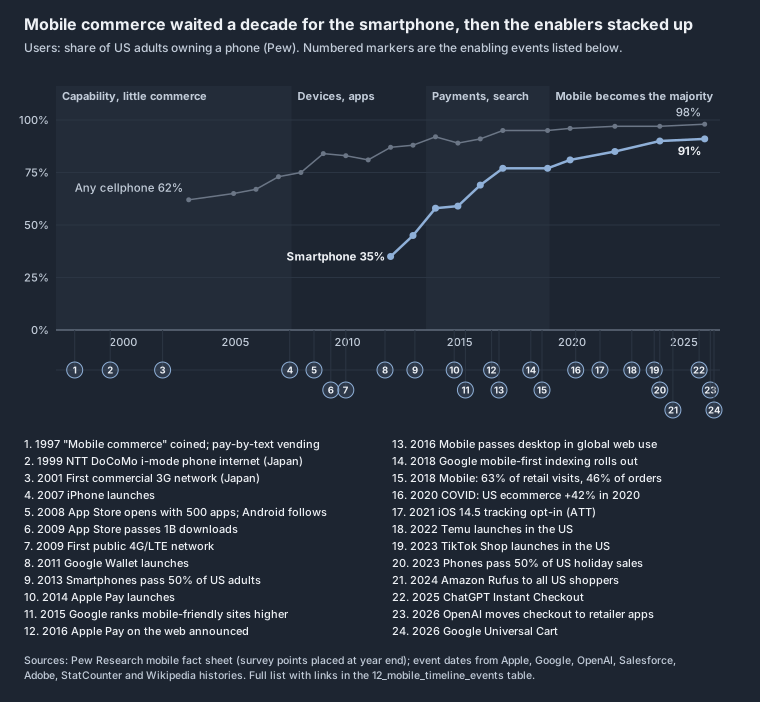
Over time, though, the spectrum expanded, and larger payloads could move through the air. Product and UX designers optimized interfaces for the small screens we were spending more and more of our time looking at, and advances in JavaScript libraries and mobile applications made richer, more complex interactions possible. Apple and Google got together with Visa, Mastercard, and AMEX. Stripe came along. Together, the payment ecosystem grew to support sophisticated, in-depth shopping and mobile experiences on our devices, anywhere, anytime.
Growth in Agent transactions feels at least somewhat inevitable
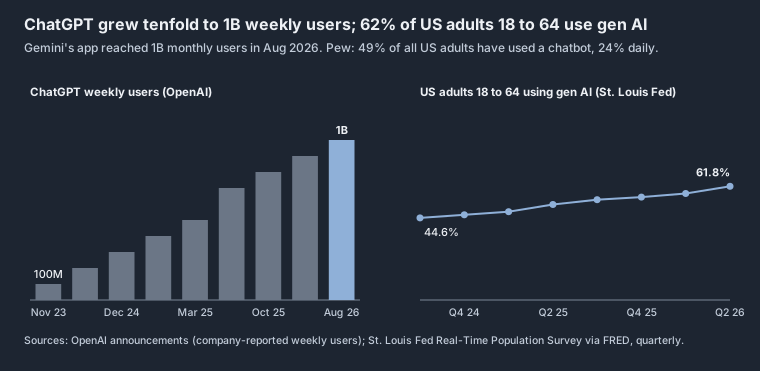
What seems clear today is that the next several years will be a battle for the attention of agents acting on behalf of humans, and brands will need to prepare their sites for that onslaught of traffic. Claude and ChatGPT already offer personal agents. Meta is launching new devices like the Tamagotchi-inspired Meta Muse that open the door to new interaction patterns, and a wave of other personal agents is emerging.
It will obviously not be immediate. The early withdrawal of OpenAI’s instant checkout after being live for just 6 months is evidence that this user experience needs to evolve. As you can see above, that was an attempt to bring the website experience into the chat via a widget. It makes sense that the old form factor is not as effective as the new form.
I think the better bet is on actually exposing the services through the chat itself, such as how Kin insurance is moving the shopping experience to Muse. Native experiences within the chat, particularly that provide utility and a seamless traversal from the research to the shopping and checkout experience is likely going to be critical to convince skeptical consumers, many of whom are not yet ready to surrender purchasing power.
Trusted problem solving will drive this growth channel
Every new channel faces the same two questions: will consumers feel secure enough to adopt it, and do they have a reason to? It was possible to perform a mobile transaction long before that modality actually took off. Mobile commerce only ballooned once the benefits became tangible — a payment card stored in an app so you could step out of an Uber (a cab!) without fumbling for your wallet, skip the line at the movie theater, or present tickets at a venue straight from your phone.
There are literally trillions of dollars searching for problems agents can solve — tasks they can take off the backs of their human operators. But a human will only feel comfortable delegating a branded interaction to their agent if they are confident the brand will help the transaction along and keep the agent in bounds: able to do exactly what it was sent to do, and nothing it wasn’t.
What’s in question is the readiness of brands to meet their customers’ agents where they are. Much of that comes down to whether a brand’s systems can be operated by software at all — whether an agent could actually place an order, check a balance, or update an address without a human clicking through screens — and whether the brand can do that safely enough to let an agent loose. A website, a mobile app, even a search engine are constrained environments: a human in a browser can only perform the tasks the brand built buttons for. The same must be true for agents. A customer’s agent will only be able to do what the brand exposes as tools — and the most likely way brands will expose those tools is through agents of their own, standing in front of their systems and fielding requests from customers’ agents.
Giving customers this kind of access to a brand’s services — account, profile, and payments management, plus the brand-specific things that matter to them: my prescriptions, my dog’s health metrics — depends on two abilities. The brand must control exactly who can touch each of its services, and it must carry an interaction across visits, so a conversation can pick up where the last one left off instead of starting from zero. In short, brands need to expose their web and app services through chat, and that requires a clean technical architecture underneath.
Pattern Engine enables users’ agents to access brand services
This is the need Pattern Factory built Pattern Engine to meet. Pattern Engine deploys in a client’s own cloud and lets a brand put agents in front of its services — agents that can see a customer’s data only when that customer has granted it, and only the data the interaction requires. Personalization has long been seen as a nice-to-have, occasionally a differentiator, mostly sorting and filtering lists and recommendations for users. In an agentic world, personalization will be table stakes, because brands will need to treat a customer’s agent as the customer — and that means giving the agent access to the customer’s data, with the customer’s permission.
To reach that level of personalization, a customer’s agent needs two things: the ability to call a brand’s services, and visibility into that customer’s data. The brand, for its part, must check every one of those calls — is this agent allowed to do this, and did this customer approve it? — so customers stay comfortable with what is being shared on their behalf. The brand must also stitch those sessions together with that permissioned data, so the agent’s third conversation knows what happened in the first two. This will prove challenging for many brands, because many serve user data from their analytics stack — the warehouses and reporting pipelines built to answer questions about customers in batches, hours or days after the fact — rather than their application stack, the live systems that actually take orders and update accounts in real time. Agents need the live systems.
Pattern Engine manages all of these challenges. It connects to the brand’s existing systems — orders, accounts, payments — and turns each one into a tool an agent is permitted to call. Its session and memory APIs record what happened in each conversation and carry it forward, building the agent’s knowledge of the customer’s relationship with the brand instead of meeting them fresh every time. And it maintains state for the things in that relationship that outlive any single conversation — a subscription, a prescription, the dog whose health metrics you track — each with its own context and access rules. The result: agents can traverse a brand’s full experience through conversation and tool usage, the way a human traverses a website — without the brand having to maintain the links and the navigation.
Meet your customers’ agents where they are.
Pattern Engine deploys in your cloud, turns your services into permissioned tools, and carries every conversation forward. Keep the store. Add the channel.
Talk to us